
Commercial premises
Shops, showrooms, offices, clinics and hotels on commercial tariff. Higher rate per unit, daytime occupancy, and accelerated depreciation on the asset.
Commercial solarRooftop solar EPC · Maharashtra & Tamil Nadu
Shakthi Solar designs, installs and commissions rooftop solar for factories, offices, warehouses, schools, hospitals, temples, churches, mosques and gurudwaras — and for homes. We handle the survey, the structure, the DISCOM file and the net meter.
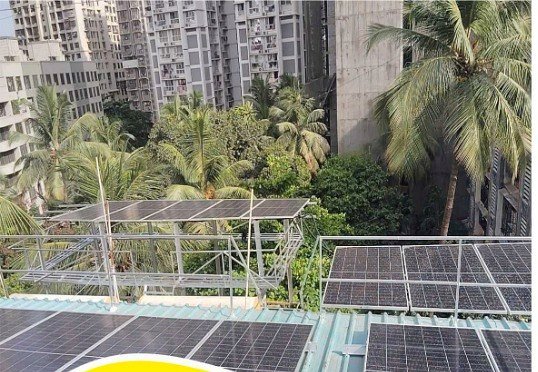
Tariffs and payback are not the same in both states. Choose yours and we will show you the numbers that actually apply to your bill.
Mumbai, Thane, Navi Mumbai, Pune, Nashik
Chennai, Coimbatore, Madurai, Trichy, Salem, Tiruppur, Erode, Vellore
Who we install for
The economics of rooftop solar are decided by two things: what you pay per unit, and whether you consume during daylight. That is why our work is weighted towards businesses and institutions.
Shops, showrooms, offices, clinics and hotels on commercial tariff. Higher rate per unit, daytime occupancy, and accelerated depreciation on the asset.
Commercial solarFactories, warehouses, cold storage and processing units. Metal sheet or RCC roofs, sized against the load curve so generation is self-consumed rather than exported.
Industrial solarEducational campuses, hostels, nursing homes and hospitals. Large roofs, steady daytime demand, and in hospitals a round-the-clock base load that solar offsets all day.
Institutional solarTemples, churches, mosques and gurudwaras. Large unshaded roofs, real daytime load, and institutional tariffs with no free units — among the best solar sites in India.
Solar for places of worshipCommon-area systems that cut lift, pump and lobby bills, plus group net metering for members. We present to the managing committee and prepare the resolution.
Society solarBungalows, row houses and independent buildings. On-grid systems from 1 kW to 10 kW, sized against your sanctioned load and your last six bills.
Residential solarA sector we specialise in
Places of worship are among the best rooftop solar sites in India and among the least served. They have large, usually unshaded roofs, they run real daytime loads, and as registered trusts they sit on commercial or institutional tariffs where every unit carries full value. What they lack is someone willing to survey an older building properly and explain the economics to a committee rather than an individual.
Sanctum and mandapam lighting, PA systems, annadanam kitchens and festival load peaks. Temple trusts usually sit on a commercial or institutional tariff with no free units, so every generated unit has full value.
Sunday peaks, parish halls, attached schools and hostels. The weekday base load from an attached institution is usually what makes the system pay, not the Sunday service itself.
Five daily prayer times, heavy fan and air-conditioning load, and a Friday Jummah peak. Wudu water heating and pumping add a steady daytime draw that matches generation well.
The langar kitchen is the single biggest load in most gurudwaras and it runs through daylight hours. That is close to an ideal solar profile — almost everything generated is consumed on site.
Where we work
Identical hardware, very different economics. This is the comparison most installers will not put in front of you.
Four distribution licensees in one state, some of the country's steepest residential slabs, and yields that vary 10% between the coast and inland.
| Licensees | Adani, Tata Power, BEST, MSEDCL |
| Billing cycle | Monthly |
| Free units for domestic | None |
| Typical yield | 118–129 units/kW/mo |
| Approval timeline | 45–90 days |
One licensee statewide, a bi-monthly telescopic tariff, and a free-unit allowance that can make a low-consumption household's bill nearly zero.
| Licensee | TANGEDCO / TNPDCL |
| Billing cycle | Bi-monthly |
| Free units for domestic | Yes — changes everything |
| Typical yield | 135–145 units/kW/mo |
| Approval timeline | 45–55 days |
Both states, one conclusion: commercial, industrial and institutional connections pay back fastest, because they pay a higher flat rate and consume during daylight. In Tamil Nadu the gap is wider still, because domestic consumers there receive free units that leave residential solar with far less to save.
Choose the right system
Nearly every building on a reliable supply should be on-grid. The other two exist for specific problems.
Panels feed the building first; surplus flows to the grid through a bidirectional net meter and comes back as credits.
Panels charge a battery bank through a charge controller. The building runs entirely off stored energy.
A hybrid inverter runs the building, charges a lithium battery for essential loads, and still exports surplus.
How it works
The stages are the same in both states; only the licensee changes.
Usable shadow-free area, structural feasibility and your last six bills. On older institutional and religious buildings the structural check comes first.
System size must stay within your sanctioned load. You get a single-line diagram, panel layout, generation estimate and a fixed written price.
Net metering application and technical feasibility with your licensee — Adani, Tata Power, BEST or MSEDCL in Maharashtra, TANGEDCO in Tamil Nadu.
Hot-dip galvanised structure, ALMM-listed modules, BIS-certified inverter, earthing and lightning arrestor. Scheduled around your operating calendar.
We coordinate the inspection, submit the commissioning report and follow the bidirectional meter until your export registers.
Monitoring app login, commissioning certificate and warranty documentation handed over, and the first cleaning visit scheduled.
Straight answers
Plan for roughly 86 sq ft of shadow-free roof area per kW. A 5 kW system needs about 430 sq ft; a 25 kW system about 2,150 sq ft.
Usable area matters far more than total area. Parapets, water tanks, lift rooms, vents, domes and towers all interrupt the layout, which is why we measure rather than estimate.
Yes, and these are among the strongest rooftop sites in India. Large roofs, real daytime load from lighting, fans, kitchens and pumping, and institutional tariffs with no free units mean every generated unit carries full value.
Older and heritage structures need a structural survey before any array is designed, and domes, towers and spires are not mounting surfaces — the array goes on flat ancillary roofs, laid out around their moving shadow.
Commercial and industrial connections pay a higher flat rate per unit than households, and they consume during daylight hours when solar generates. That combination pushes self-consumption above 80%.
A self-consumed unit is worth the full retail tariff; an exported one settles at a fraction of it. So matching generation to a daytime load curve matters more than filling the roof.
Two to four days of physical work on a small rooftop; longer on an industrial shed or an institutional building needing structural reinforcement. Application to a working net meter is 45 to 90 days in Maharashtra and 45 to 55 days in Tamil Nadu.
Mechanically almost none — there are no moving parts. What both states demand is cleaning: coastal salt in Mumbai and Chennai, industrial dust around Salem and Wagle Estate, and monsoon grime everywhere can cost 8–15% of generation if panels are left unwashed. Our AMC covers scheduled cleaning, inverter health checks and a plain-language generation report.
Maharashtra — Mumbai, Thane, Navi Mumbai, Pune and Nashik — and Tamil Nadu — Chennai, Coimbatore, Madurai, Trichy, Salem, Tiruppur, Erode and Vellore. Each city page carries its own yield figure and local notes.
Send your last electricity bill and your building address. You get a shadow-aware system size, the roof area it needs and a fixed written price — and an honest answer if it is not worth doing.